
Hello KSKOers
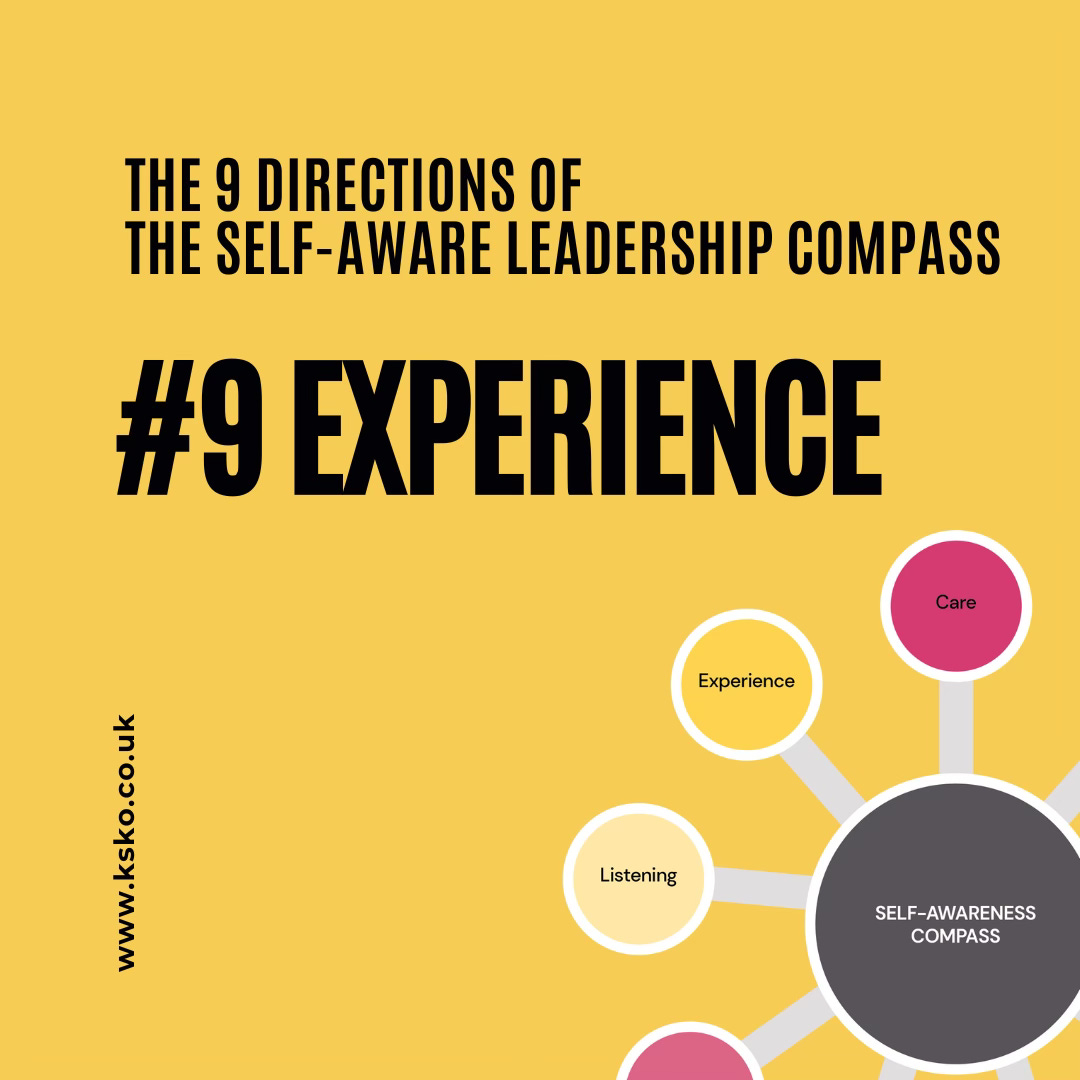
In this edition, I’m sharing an excerpt with you from The Self-Awareness Superhighway: Charting Your Leadership Journey, all about experience. Experience is the ninth and final direction of the Self-Aware Leadership Compass and the eighth letter of the nine CHARTABLE directions.
“If you take the superhighway of EXPERIENCE, your flight will mean learning from your experiences and sharing what you know with others to nurture their growth and development.”
Looking forward to joining you on your learning journey!

“I never lose. I either win or learn.” Nelson Mandela
Intertwined with humility and reflection is learning from experience and sharing experiences. Fundamental to the onward journey of self-aware leadership is learning – your own and that of others. We’ve already set out the argument that leadership is not a skill that can be learnt, like a technical skill; there must first be an innate ability that is cultivated, nurtured and developed through learning. And what better way to learn than by experience? As a leader determined to develop your hard and relational self-awareness skills, it’s your responsibility to seek out exposure to learning opportunities. Likewise, it’s incumbent on you to pass on those opportunities for experiential learning to others. You need to strive forward on your journey, push through the hurricanes, battle through the storms and hunker down in the typhoons because you will, without a shadow of a doubt, become a better version of yourself for having learnt from experience – what you would do bigger, better, faster, more of… next time.
Let’s journey along route number nine and follow the final compass point on your journey of self-aware leadership: experience.
The Leadership Behaviours Framework for Senior Leaders, developed by Academi Wales (the leadership and management development body for the Welsh public sector),29 identifies the core leadership behaviours of learning, self-awareness, drive and resilience. As core leadership behaviours, learning and self-awareness are described as the capacity for learning from experience and feedback and adapting one’s approach to take account of that learning and feedback. Academi Wales is of the view that learning and self-awareness matter because they support a leader to grow, improve, reduce repeated mistakes and facilitate other behaviours necessary for high-level performance.
Experience is considered an element of self-awareness.30 The experience you gain from leading in a crisis means you can use it to mould your leadership styles and learn how to improve for the future31 because “leadership is hardwired through the experience of adversity”. As Confucius says, it is one of the ways to learn wisdom. When you’ve engaged in a social or collaborative learning experience, the knowledge and skills you acquire become neurologically embedded and stick better in your brain.32
In general terms, you ‘know’ your world through your experiences, and your experiences are individual to you. There are, of course, instances where you know a rock is heavy and a car is fast because of the weights, measurements and speeds set out for you by science. But excluding all the things that are solid, tangible and quantifiable, everything else is a story. You know that if you have two people in a room, both will leave remembering the same, similar and different things. If 20 people watch the Tour de France, you’ll get 20 differing accounts. When my husband and I go out to a restaurant, I’ll be able to describe the décor, where the other diners sat, what they wore and how they behaved towards each other. My husband will recall who said what to whom and the details of the menu. Neither of us will be able to recall the same thing as the other.
You experience the world in relation to others by the stories you tell yourself and the ones told to you by others. You perceive your world through the senses you have available to you, your natural dispositions to observe certain things, your different interests, your biases, your culture, your religion and what you’ve learnt from your parents, families, communities and past experiences. Assistant fire chief Chad Costa (episode 23) said that life experiences like marriage and having children change you. You can add illness, bereavement, divorce and house moves to that list. The experiences that impact and change you influence the way you see and experience the world and the stories you tell yourself and others about it. You live, rocks and cars aside, in a socially constructed world.
This idea of lived experience connects to the discussion in Part 1 about nature versus nurture and whether it’s really possible to learn leadership. As you’ve read, this book takes the stance that leadership can’t be learnt without either some evident or undiscovered leadership attributes being innately present. You can, however, build on the innate capabilities you have, through formal learning and experiential learning.
You generally learn from experiencing things via the indirect stories of others or by directly experiencing things yourself. Putting in place opportunities to experience and learn from others through mentoring, supervision, masterclasses and training are positive ways to hear the stories and learn from others through indirect experiences. These are helpful for individuals recently promoted to leadership and management positions or people new to their roles because they provide supplementary learning experiences that can be tapped into whilst doing the day job.
Direct experiences can also be sought out. Shadowing, internships, volunteering, on-the-job learning courses, promotion, interim roles or doing roles at the cusp of your circle of knowledge are all ways to instigate direct learning opportunities. These lend themselves to situations where you’re more ready and able to relinquish your substantive role, either wholly or partially, permanently or temporarily.
Within organisations, the sharing of experiences is generally through internal and external communication, and communication here is meant in its very broadest sense – for example, the language and vocabulary that’s used and the nuances given in corporate messaging, like how reports are written, whether the history of the organisation is talked about, what social media communications are put out into the world and the tone of the leadership and management courses endorsed by the organisation.
One of the underpinning skills of internal and external communication is storytelling. The benefits of storytelling are widely acknowledged. Storytelling is also about evidencing the impact of your efforts. Storytelling as a business skill has been gaining momentum over the last 15 years (in the public sector in the UK, at least) alongside the embracing of results-based accountability and the use of qualitative and outcomes measures. If you want to be able to determine the outcome of your work, you have to be able to tell the qualitative story and justify your financial investment by proving that someone was better off after your efforts than before. You’re already adept at telling the quantitative story, but telling the qualitative story is a work in progress. You need to be able to share your work experiences and the impact they’re having on others to be able to justify the continuation of your job. If you can’t set out a story of impact, why would anyone want to continue employing you? In your organisation, this might fall under the banner of productivity.
There are examples of managers preparing staff at operational and business levels for promotion because they’ve seen potential in those individuals. You can encourage people to find external coaches and mentors, organise shadowing opportunities, give people chances to step up into temporary promotion positions, ask them to attend senior meetings to present papers and get their names on the radar. Also consider this in instances where individuals don’t have the level of confidence in themselves that you have in them – where you’re able to see their potential as strategic thinkers, integration and engagement experts and leaders well before they can.
When you consider people in your organisation who show potential and innate leadership capabilities, they will benefit greatly from training and increased exposure to experiential learning opportunities. And the organisation will benefit alongside them. In many cases though, organisations let good talent go to build their experiences elsewhere, and hope they’ll come back one day when they’ve built up those skills.
There’s definitely an argument for supporting people to gain a broad range of experiences in different roles, within different organisations and sectors, but this has to be weighed up against the unintended consequences of creating a churn of people joining and leaving organisations. More work needs to be done in terms of developing case studies and facilitating storytelling as a means of nurturing individuals working their way up the career ladder so that they stay a bit longer, create a bit more stability within organisations and then move on in a planned way, not a running-for-the-hills kind of way because the organisation doesn’t nurture them to grow in knowledge and skills.
As a self-aware leader on their journey of improvement, you need to suck every drop of learning from your experiences. And when you’ve done that, as a caring, humble, relationship-focussed leader, you need to create a tsunami of sharing with your colleagues to foster an organisational culture of learning, failing and learning again, underpinned by the psychological safety, confidence, trust and back-up to do so.

Here are five top tips to develop your self-awareness and self-aware leadership with ‘experience’ in mind:
Seek and Create Learning Opportunities: Actively pursue experiences that offer learning opportunities, such as shadowing, internships, volunteering, and interim roles. Encourage your team to do the same by providing mentorship, supervision, and training.
Embrace and Share Experiences: Learn from your own experiences and share those lessons with others. Use storytelling to convey the impact of your experiences, helping others learn indirectly and fostering a culture of shared learning.
Reflect and Adapt: Regularly reflect on your experiences and feedback to adapt your approach. This reflection helps you grow, avoid repeating mistakes, and improve your leadership capabilities.
Develop a Supportive Environment: Create an environment that supports experiential learning and psychological safety. Encourage open communication, trust, and confidence, allowing your team to learn from failures and successes.
Recognise and Nurture Potential: Identify and support individuals with innate leadership potential by providing them with growth opportunities. Offer chances for promotion, participation in senior meetings, and other forms of exposure to help them build their skills and confidence.
By integrating these practices, you can enhance your self-awareness and leadership effectiveness.

Nia is an expert leader who talks the talk and walks the walk. She is an academically awarded thought leader in self-aware leadership and practices self-aware leadership every single day in her role as a Director in a Children’s Charity.
Find out more about Self-Aware Leadership by getting your very own copy of The Self-Awareness Superhighway! It’s an Amazon Best Seller in.....
🥇Business Management & Leadership
🥇Occupational & Organisational Psychology
🥇Business Careers