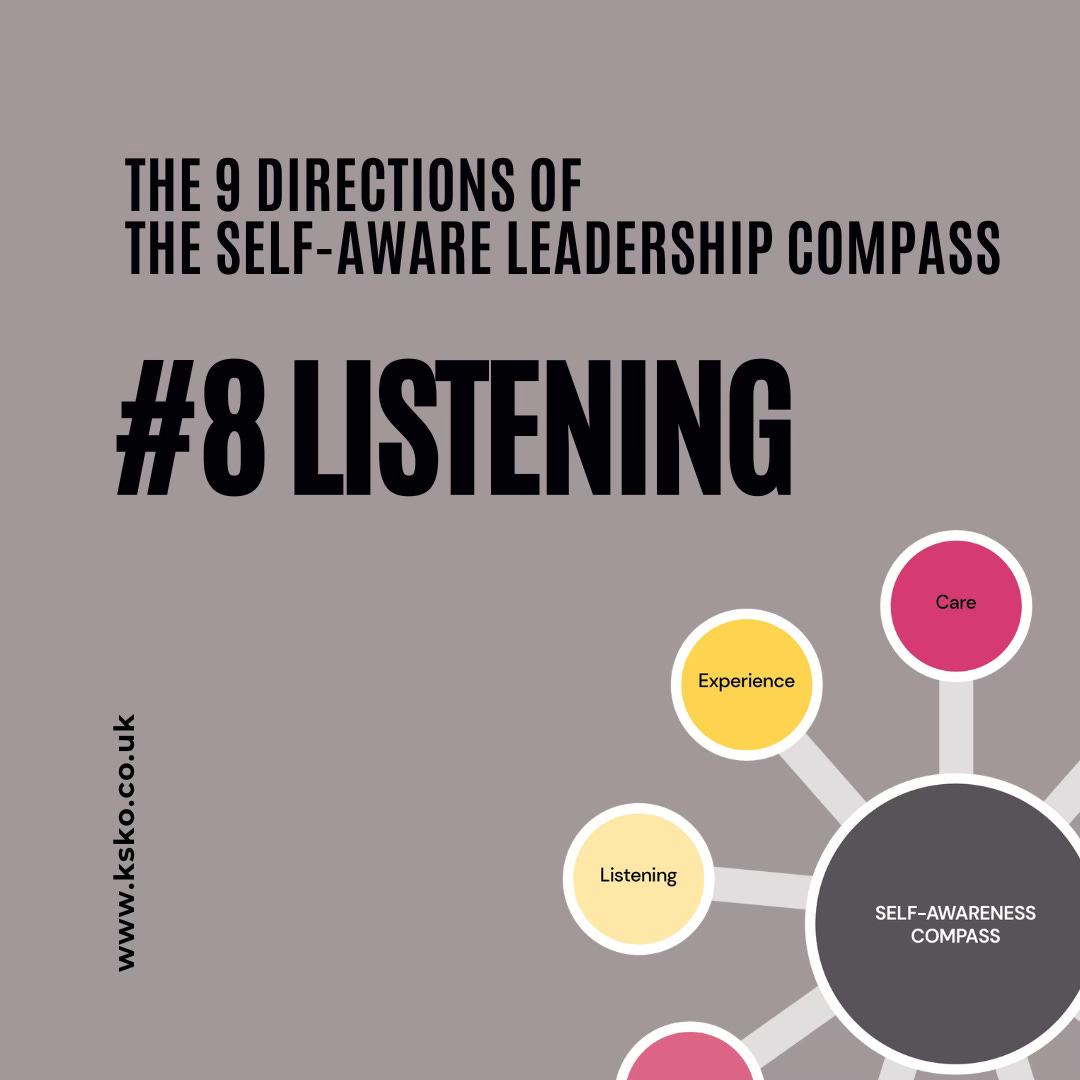
The Self-Awareness Compass: Direction #8 - Listening
Knowing Self-Aware Leadership
Hello KSKOers
In this edition, I’m sharing an excerpt with you from The Self-Awareness Superhighway: Charting Your Leadership Journey, all about listening. Listening is the eighth direction of the Self-Aware Leadership Compass and the eighth letter of the nine CHARTABLE directions.
“If you take the superhighway of LISTENING, you are heading on a voyage of giving voice to the quieter and marginalised people in your organisations to ensure everyone is heard.”
Looking forward to joining you on your learning journey!

“Knowledge speaks, but wisdom listens.” Jimi Hendrix
Being ignored, being marginalised, not valued, bypassed, just a number. What’s your name again? You have to listen to understand, and you have to listen to respond too. The meme that does the rounds every so often saying, “You should listen to understand, not to respond” doesn’t feel realistic to me. Of course you have to respond and, particularly as leaders, you’re often expected to have most if not all the answers ready to share. Your humility gives you the opportunity to say, “I don’t know,” but that doesn’t mean it’s always a satisfactory response to unhappy people. How then do you put those two things together to ensure you both hear the voices of your colleagues and employees and are able to respond in real time, or at least within a reasonable time?
Let’s journey along route number eight and follow the compass point of listening.
I used to go to a regular meeting made up of about 30 or so attendees, and in that meeting, there were three or four voices that would dominate the discussion. No matter who chaired the meeting, they couldn’t control the amount of airspace these people consumed. Their voices were so loud in the room that most of them, at one time or another, had been voted into the role of the chair in the hope they would either be quieter or take up the whole of the agenda and give us all a day off with a free lunch. A day or two before the meeting, I would often check who was attending and who had sent apologies. If any of the loud few were in attendance, I’d feign an illness or an urgent matter that needed to be dealt with as often as I could without being conspicuous by my absence. The inability to create listening space to hear the voices of others was jaw-dropping. The eye rolling, yawning and email answering that went on in that room on those days made it a very expensive waiting room!
Active listening is an essential function of leadership. It’s a critical mechanism for getting to know yourself better through the eyes of others (recognition) and giving yourself the best opportunity to behave in the way you would most want in any situation (regulation). It also ensures people feel heard and are heard. If you think about the recognition layer of self-aware leadership, it’s about using all the senses you have at your disposal to take in what another person is communicating. I should clarify, when we talk about listening in this book, it’s listening to what’s being said, how it’s being said and what’s not being said and ‘listening’ to what’s being subconsciously conveyed too. This compass point includes inter-relational communication in all its guises: verbal, non-verbal and visual. As a self-aware leader, you need to listen to what’s being said, how it’s being said and the harmony or dissonance between the two.
As a leader, you need to create listening environments. You’ve already read about extroverts and introverts and how difficult it is for introverts to find that space in the conversation to raise their voice. Your job as a leader is to create those spaces and opportunities. Virtual meetings are good for generating these opportunities. Everyone being in a little virtual square is a pretty good leveller, provided the rule of engagement is that people use their little yellow hand to make a point. I talked to coach for introverts and quiet achievers Serena Low (episode 46) about this. She said extroverts can dominate virtual discussions too and don’t always use their little yellow hand! This means the role of the discussion facilitator is to lay out the ground rules to ensure listening is set as one of the operating standards of the session and there are opportunities for quieter voices to be heard.
I struggle not to talk over the end of people’s sentences. Apparently this is a common trait of introverts, as we’re not very good at jumping in before the extroverts and then misjudge when someone else has finished speaking. I do my best to write down my thoughts and bring them up when the conversation has ended, but I don’t always manage it and I’m not always guaranteed to get my two penn’orth in before the louder voices. I do, however, own my faux pas and you’ll often hear me saying, “Sorry, I cut across you there” as a way of living my compass points of care, humility, authenticity, reflection and modelling behaviour.
I recently did two podcast interviews where I’d asked my guests a really good question, and as they were answering, I threw in a side comment. They totally lost their thread, and I totally forgot what I’d asked them. I was listening to work out what I could ask them next so that the podcast could be engaging, relevant and had flow. This is my greatest challenge – listening whilst holding on to a comment related to something someone said earlier for long enough so that I can come in and make it. I’ve usually forgotten it by the time I get the chance, and you’ve missed the benefit of my wit and wisdom!! Listening, hearing and responding are tough skills to master!
I heard Oscar Trimboli, an expert in listening and the author of Deep Listening, talking to Jon Rennie on the Deep Leadership podcast. His website is a treasure trove of useful resources for listeners and people who want to improve their listening. He sets out five layers of listening: listening to yourself, listening to the content, listening to the context, listening to the unsaid and listening for meaning. There’s a quiz on Oscar’s website that “will help you identify your Listening Villains, and provide you with a clear understanding of your number one listening barrier”. I took it, being that I have an interest in self-awareness, don’tcha know, and my listening villain is ‘The Shrewd Listener’…
“Savvy thinker – fixing fixated – three steps ahead of the wrong problem. Shrewd Listeners are obsessed with solutions rather than listening. You are too busy trying to solve the issue before you have properly listened to the situation and explanation.”
Don’t you just hate it when these things are right? Take the test, I dare you!
I liked what Jon Rennie (episode 11) said about the need to listen to everybody. He said, as leaders, we should cultivate our complainers because they might just be trying to make things better. Some people who complain do so from a place of genuine concern, and their concern has built up to a grievance through frustration because no one was listening. When you think about the complainers, a self-aware leader needs to separate out what’s being said from how it’s being said. If you’re dealing with someone who’s been labelled a complainer, it might be that how they’re raising a challenge is simply rubbing people up the wrong way. If you take the how out of the what, it might be that the substance of what they’re trying to say is valuable and important to the existence of your company. As Jon said, if you’re a leader, you’ve really got to develop a thick skin and learn to be open to the complainers. Different people convey their emotions in different ways, and some people may not fall within your experience of atypical emotional displays. Listen to your complainers, and maybe, just maybe, they’ll be throwing you a lifeline that you didn’t know you needed!
When I talked to Alison Smith (episode 4), she spoke about communication and said, what you give out, you get back: the meaning of the communication is the response you get, which is quite a humbling thought. If people receive what you’re saying in a way that you didn’t intend, consider that it’s unlikely to be their fault. Did you communicate appropriately for your audience? Being that ‘you can’t change others, you can only change yourself’, consider the things within your locus of control and listen to the responses you’re getting. If they don’t align, change what you’re saying.
A Harvard Business Review article titled ‘What Great Listeners Actually Do’ by Jack Zenger and Joseph Folkman sets out what great listeners actually do: they ask questions that promote discovery and insight, have interactions that build self-esteem and create a safe environment, have co-operative conversations where feedback flows both ways; they make suggestions skilfully and open up alternative paths to thinking and problem solving.
They also describe six levels of listening:
1. Create a safe environment to discuss.
2. Clear away distractions and make eye contact.
3. Understand the substance, ask questions and confirm.
4. Observe non-verbal clues.
5. Understand emotions and feelings about the topic.
6. Help other people to see issues in a different light.
These are incredibly helpful steps along a journey to improved and active listening.
To listen better, you need to work on your own active listening skills. To hear better, you need to work on your organisation’s hearing mechanisms. If you want to operate as an effective self-aware listening leader, you need to consider the environment, methods, standards and opportunities for your colleagues to be engaged and feel safe enough to speak, write and indicate in whatever way is most appropriate to them, their thoughts, ideas and views.
Here are five top tips to develop your self-awareness and self-aware leadership based on the provided text:
Practice Active Listening: Focus on genuinely understanding what is being communicated, including verbal, non-verbal, and unspoken cues. This involves listening to what is said, how it is said, and what is left unsaid.
Create Inclusive Environments: Foster spaces where all voices can be heard, especially quieter ones. This can be achieved through structured methods like using virtual meeting tools that require hand-raising to speak, ensuring everyone has an opportunity to contribute.
Respond Thoughtfully and Humbly: Balance listening to understand with the need to respond. Recognise that saying "I don't know" is acceptable but strive to provide meaningful and timely responses to foster trust and respect.
Embrace and Learn from Feedback: Be open to feedback, including from complainers. Separate the content of their feedback from the delivery method to uncover valuable insights that may benefit your organisation.
Reflect on and Adapt Communication: Continuously evaluate and adjust your communication style based on the responses you receive. Ensure your message is appropriately tailored to your audience to avoid misunderstandings and improve engagement.
These tips will help you become a more self-aware leader who listens effectively and creates a positive, communicative organisational culture.
Nia is an expert leader who talks the talk and walks the walk. She is an academically awarded thought leader in self-aware leadership and practices self-aware leadership every single day in her role as a Director in a Children’s Charity.
Find out more about Self-Aware Leadership by getting your very own copy of The Self-Awareness Superhighway! It’s an Amazon Best Seller in.....
🥇Business Management & Leadership
🥇Occupational & Organisational Psychology
🥇Business Careers